IGF-1 LR3 (Insulin-like Growth Factor 1 Long R3) has emerged as one of the most effective peptides in research settings for enhancing muscle growth, optimizing fat metabolism, and supporting physical performance. A synthetic analog of IGF 1, this peptide is valued for its role in accelerating muscle repair, increasing protein synthesis, and promoting muscle cell proliferation. With proper use, IGF 1 LR3 may aid in everything from reducing body fat to stimulating muscle hypertrophy and lean muscle gain.
This article outlines the ideal IGF-1 LR3 dosage strategies for both fat loss and bodybuilding, explains how it interacts with the human body, and includes a detailed dosage chart based on weight and gender. It also addresses safety considerations, potential risks, and key physiological mechanisms including nutrient partitioning, amino acid utilization, and the impact on blood glucose levels while focusing on minimizing potential risks.
What Is IGF-1 LR3 and How Does It Work?
IGF 1 LR3 is a modified version of the naturally occurring insulin like growth factor 1, designed to offer improved performance characteristics. It differs from standard IGF 1 by including an arginine substitution at the third position and an extended amino acid chain at the N-terminus. These changes reduce its affinity for IGF binding proteins, which allows it to remain active in the bloodstream for up to 24 hours—significantly longer than standard IGF-1’s 20-minute half-life.
Once in circulation, IGF-1 LR3 binds to receptors on muscle cells, initiating processes like muscle protein synthesis, cell proliferation, and glucose uptake. These effects not only aid in muscle recovery and injury recovery, but also contribute to muscle tissue repair, bone density, and the formation of new muscle cells. Because of its ability to act independently of the liver, it also enhances the output and function of growth hormone pathways and is particularly effective during post-exercise windows.
IGF-1 LR3 Dosage for Fat Loss
In fat-loss protocols, IGF-1 LR3 works by promoting insulin sensitivity to improve insulin sensitivity, improving nutrient partitioning, and directing nutrients toward lean muscle instead of adipose tissue. Its metabolic influence stems from its ability to enhance amino acid absorption and stimulate fat metabolism while preserving lean body mass. Many researchers report that subjects experience a noticeable reduction in body fat, improved glucose uptake, and maintenance of lean muscle mass even during a calorie deficit.
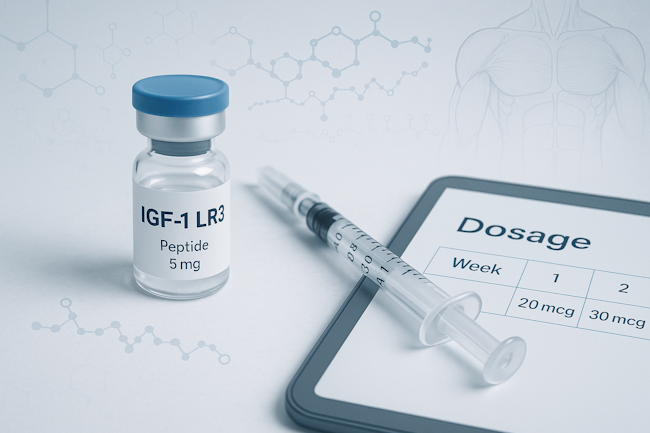
The typical dosage for fat loss ranges between 20 to 40 micrograms per day. It is generally administered subcutaneously either in the morning or post-workout to align with natural growth hormone peaks and maximize nutrient uptake. A common schedule involves using it for five days on and two days off over a four to six-week cycle. This helps maintain its efficacy while reducing the risk of desensitization or low blood sugar side effects. Over the first few weeks, users may notice subtle improvements in joint pain, muscle recovery, and energy levels as insulin like growth activity increases.
IGF-1 LR3 Dosage for Bodybuilding and Muscle Growth
For those pursuing muscle growth, IGF-1 LR3 plays a pivotal role in activating satellite cells, encouraging muscle cell formation, and enhancing the development of existing muscle fibers. It contributes to accelerated muscle regeneration, promotes muscle hypertrophy, and supports greater muscle mass and muscle density by amplifying the effects of growth hormone and related growth factors, facilitating new muscle cell formation . The increase in muscle protein synthesis and retention of amino acids also aids significantly in enhanced recovery and muscle healing between training sessions.
In bodybuilding protocols, daily dosages typically fall in the 40 to 80 microgram range, depending on body weight and experience level. This dosage is often administered post-workout when nutrient partitioning and glucose uptake are most active. Like with fat loss applications, a five-days-on, two-days-off cycle is frequently adopted, spanning four to six weeks. This peptide’s longer activity window allows for more efficient protein synthesis and the preservation of lean mass, making it a strong addition to both bulking and cutting cycles.
IGF-1 LR3 Dosage by Body Weight and Gender
Individual needs can vary significantly depending on gender, training intensity, and body mass. Below is a general guideline for IGF-1 LR3 dosage based on body weight, broken down by typical ranges for men and women:
| Body Weight (lbs.) | Men (mcg/day) | Women (mcg/day) |
|---|---|---|
| 100 – 130 | 20 – 30 | 10 – 20 |
| 131 – 160 | 30 – 40 | 15 – 25 |
| 161 – 190 | 40 – 60 | 20 – 30 |
| 191 – 220 | 60 – 70 | 25 – 35 |
| 221 – 250+ | 70 – 80 | 30 – 40 |
These ranges are meant for general reference. Users are encouraged to start at the lower end of the scale to assess tolerance and monitor blood glucose responses. Those with a history of growth hormone deficiency or insulin resistance should proceed with caution and consult a healthcare provider before initiating use.
Physiological Impact on the Human Body
IGF-1 LR3’s broad spectrum of action is attributable to its central role in supporting the body’s ability to grow, recover, and maintain muscle tissue. By mimicking natural IGF 1 and enhancing its interaction with growth hormone receptors, it stimulates muscle cell proliferation, facilitates new muscle cell formation, and increases the rate of tissue repair.
This peptide is not just about muscle; its regenerative properties extend to ligaments, tendons, and even nerve tissues, aiding in injury recovery and enhancing cognitive function in certain contexts. Through improved glucose uptake, more energy is available for muscle development, while increased nitrogen retention supports long-term anabolic growth.
IGF-1 LR3 vs. IGF-1: What Sets LR3 Apart?
The original IGF 1 produced by the liver in response to human growth hormone has a limited duration and is quickly neutralized by IGF binding proteins. IGF-1 LR3, however, remains active in the system for much longer and acts directly on muscle cells without needing intermediary hormonal signals. This extended bioavailability makes it especially useful in scenarios requiring prolonged muscle protein synthesis, sustained muscle cell activity, and long-term anabolic support.
Because of these enhancements, IGF 1 LR3 is widely considered a valuable tool for promoting lean muscle gain, muscle regeneration, and improved athletic performance than unmodified IGF-1.
Safety Considerations and Potential Risks
As with any potent research peptide, IGF-1 LR3 comes with potential risks. While many users report dramatic improvements in muscle mass, lean muscle, and body composition, it’s essential to approach with an understanding of both the benefits and limitations.
Primary safety concerns include the potential for low blood sugar (hypoglycemia), particularly when fasting or consuming inadequate carbohydrates. Some may also experience joint pain, water retention, or digestive issues. Overuse may carry an increased risk of unregulated cell growth, especially with long-term, high-dose protocols. These risks can be mitigated by cycling off regularly, monitoring blood glucose levels, and avoiding concurrent use with untested other peptides.
To help minimize these effects, begin with a conservative dose, follow a structured cycle, and track any physiological changes closely. Users should also maintain a consistent diet rich in complex carbohydrates and amino acids, allowing for optimal nutrient uptake and muscle tissue support.
Optimizing Results with IGF-1 LR3
Success with IGF 1 LR3 is tied not just to its dosage but also to the surrounding training, nutrition, and recovery strategies. Timing the injection post-exercise takes advantage of the natural spike in growth hormone and allows for greater muscle protein synthesis. Diets emphasizing lean proteins, healthy fats, and moderate carbs help support the increased demand for glucose uptake and nitrogen retention.
Those using IGF-1 LR3 for muscle hypertrophy should follow resistance-training protocols that stress the muscles adequately and allow for rest days to facilitate muscle healing. Individuals focused on fat loss should combine its use with a mild caloric deficit and light cardiovascular training to enhance the peptide’s impact on fat metabolism and insulin sensitivity.
Final Thoughts
Whether the goal is building lean muscle mass, accelerating muscle recovery, or reducing body fat, IGF-1 LR3 represents a powerful tool and significant advancement in performance-enhancing peptides. Its influence on growth hormone, insulin like growth, and cellular regeneration processes makes it not just a peptide for muscle growth, but a broader agent for full-body transformation.
However, it’s important to respect the peptide’s power, recognize its potential for misuse, and apply protocols backed by research and medical oversight. The key is in the proper dosing, consistent monitoring, and attention to individual tolerance and long-term objectives supported by clinical research . With informed use, IGF 1 LR3 can be an exceptional addition to any serious fat-loss or muscle-building regimen.